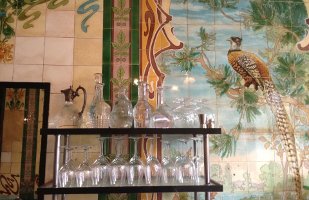
The pleasure of a vacation comes in at least three parts: First is the anticipation. You makes lists, peruse websites, and weave fantasies about the place you’re visiting. Then comes the actual vacation. Finally — and perhaps this is the real meat of the pleasure — you fold the whole experience into stories you tell yourself and share with others, letting you live the good bits over and over, and allowing you to absorb the more puzzling parts.
I’ve only spent a meager three and a half days in Paris so far, but if you’ll indulge me, I’d like to get started on stage three — the telling — in bits and pieces:
- First, the smells. I was barely off the metro, baggage in hand, stumbling to the apartment where I’m staying, and boom! there it was: the aroma of caramelized sugar and butter…

 Fill up your pomanders, take out your nosegays: it’s going to be a hot summer. “In the late summer of 1880 in Paris, death was in the air and it smelled like excrement.” So begins David S. Barnes’s history of the birth and dissemination of public health in France. The author shows that scientific discovery alone did not change the way a nation understood sanitation and the spread of disease. Eberth and Klebs’s isolation of the typhoid bacillus (1880), Roux’s diphtheria antitoxin (1884), Pasteur’s work on anthrax (1881) and development of the rabies vaccine (1885) were the talk of the town, but that wasn’t enough. It took a convergence of ideas (new scientific knowledge, persistent folk etiologies of contagion, a shift in political thinking toward Republican positivism, increased secularization, France’s mission to “civilize” the peasantry and colonies) to garner acceptance of germ theory and support for sanitation control.