“Headspace” (a term borrowed from the beat generation, where it connoted psychological privacy) is the technical term for the area surrounding an object or person in which their odour can be analysed. But odour detection is not limited to the discovery of drugs and explosives. Scientists and electronic nose entrepreneurs claim headspace analysis can reveal everything from the substances people have been in contact with and their emotional state, to their personal identity and ethnic origin…
More future shock
Ah! A bold espresso that boasts intense flowery, winey, citrus, acid — and yes, even butter toffee notes. So says an electronic nose, anyway.
Behold, the coffee snob of the future.
Perhaps the machine assembled by scientists at the Nestlé Research Center in Switzerland isn’t quite ready to be called into daily demitasse-sipping service. But in an analytical test of its abilities, it predicted the range of aromas and intensities noted by a panel of experts for 11 different espressos, with few mismatches.
— More "electronic nose" news (see yesterday's Future Shock post). Read more at Electronic nose knows quality coffee at MSNBC. Thanks to Ruth for the link!
Future shock
Engineers have been successful in creating sensors that detect specific smells. But when it comes to replicating the entire discriminating ability of a nose - well, that's nothing to sniff at.
But a Palo Alto entrepreneur believes it can be done.
— From Can a computer have a sense of smell? in the San Franciso Chronicle, with thanks to inkdarkmoon for the link!
And all this science I don’t understand…
A Nobel laureate and her co-authors on a 2001 paper on the sense of smell have retracted the study, saying they had discovered problems in the data and were unable to duplicate their findings.
Linda Buck shared the 2004 Nobel Prize in medicine for her work on smell. It was not immediately clear how important the retracted research, done in mice, was to the body of work that led to her Nobel.
— Read more at Nobel laureate recants key paper on smell, at SFGate. Thanks to Clare for the link!
The Scent of Desire: Discovering Our Enigmatic Sense of Smell by Rachel Herz
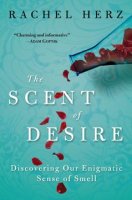 I've been looking forward to Rachel Herz' book for a long time. I found out about her work on the psychology of smell several years ago, and although I never got around to reading her academic work (published in reputable journals like the American Journal of Psychology and Chemical Senses), I did keep track of her frequent interviews in the popular media. The Scent of Desire is her first book, and tackles a wide range of questions on the relation between emotion and olfaction. From odor-emotional conditioning and olfactive memory to cultural differences in odor familiarity, Herz explains how odors influence our social relationships and mental health.
Smell is both a detector of danger, and a vehicle of desire. As the title suggests, The Scent of Desire is primarily focused on the latter. The author's basic premise is that emotional experience and the sense of smell are fundamentally interconnected…