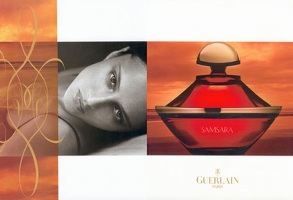
According to Michael Edwards in Perfume Legends, Guerlain Samsara was the result both of love and a calculated business decision.1 First the part about love. In 1985, Jean-Paul Guerlain made a perfume for an Englishwoman he wanted to seduce. She said she liked sandalwood and jasmine, so he designed for her a fragrance loaded with both notes. She wore it faithfully and told him people would cross the street to ask what her perfume was. (I guess when the chief perfumer for Guerlain supplies you with free, custom perfume, you wear enough to be smelled across a couple of lanes of traffic.)
Now the business angle. About the same time Jean-Paul was pitching woo to his English girlfriend, the house of Guerlain was rethinking its business strategy. For a century the company had created fragrances it thought were pretty, and marketing played a backseat role. By the mid-1980s, perfume wasn’t just a luxury item created by a handful of perfume houses anymore. The tidal wave of entities selling perfume that now includes car manufacturers, jewelers, country music stars, and even fast food restaurants was just cresting the horizon. Guerlain realized it had better draw up a new business model.
Big, exotic perfumes were popular. Yves Saint Laurent Opium raced to the top of the charts in 1977, and Chanel Coco followed in 1984…