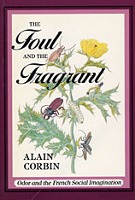
 The last two books we’ve discussed (Classen’s Aroma and Süskind’s Perfume) give a good impression of the malodors that infested the streets of 18th century Paris, and of the negative connotations attributed to smell since the Enlightenment. Alain Corbin’s The Foul and the Fragrant fits well in this context, as it explores the relation between odors and hygiene in 18th and 19th century France. It traces back the social history of smell, particularly in the French capital, with the aim to better understand the “deodorized” world in which we live today.
Ever wondered how we ended up being so intolerant towards stench and body odor? You may think the answer lies in the invention of modern hygiene and deodorants, but according to French historian Alain Corbin, things are not that simple. Indeed, we sometimes forget just how radically science has changed our outlook on Nature in the past centuries; what looks obvious to us, may have been inconceivable to our ancestors. The Ancient Greek’s assumption that air, fire, water, and earth are the primordial elements of life serves as a small reminder: it wasn’t until the second half of the 18th century that Empedocles’ ideas were debunked by empirical science (think of Joseph Priestley, Antoine Lavoisier, Joseph Louis Gay-Lussac, John Dalton, Amedeo Avogadro).
Taking this into account, it’s hardly surprising to see how the concept of “bad air” meant something very different to people in 1750 than it does nowadays…
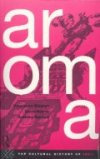 There's something convenient about social sciences: you don't need a master's degree in anthropology or sociology to understand the literature involved. I've decided to make good use of this fact, and shine some light on a product of genuine academic labor. Aroma is not a book about perfume, but if you have even the faintest interest in the culture of smell, this is an absolute must-have. Written by a trio of Canadian anthropologists in 1994, it was the first proper attempt to explore the social role of smell through history and across cultures. While it's no longer the only good book on the subject, it certainly hasn't lost its refreshing, original appeal yet.